
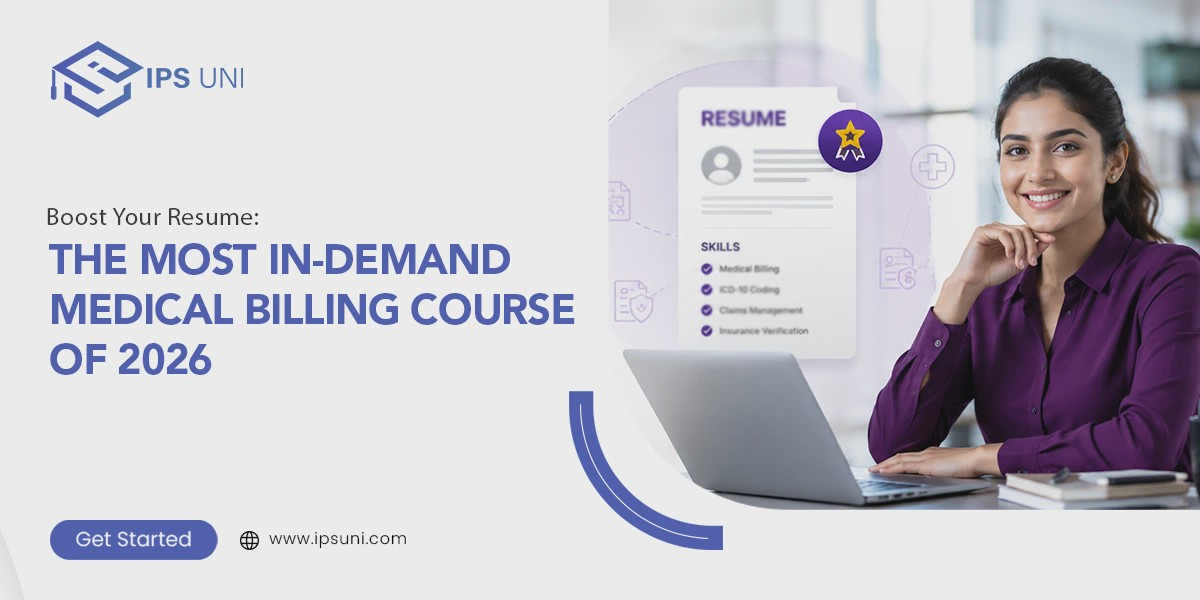
It can be hard to get your first job in healthcare if your resume lists nothing but a degree and some basic computer skills, since a medical billing course will enable you to gain practical skills that employers can put to use.
In 2026, healthcare companies are increasingly demanding workers who can accurately handle billing, insurance, records, and clear communication.
A medical billing course from a trusted Short Courses Institute, like IPS Uni gives your resume a clear, professional edge. Rather than just mentioning your education, you can demonstrate that you have acquired practical skills in a field that is rapidly expanding.
Healthcare involves more than just doctors and nurses. Behind each patient visit, there are records, insurance checks, claims, payments, and follow-ups.
The medical billing course shows students how these procedures function and also gives them an introduction to areas including eligibility verification, claim submission, payment posting, denial management, and accounts receivable.
The skills are valuable since doctors and other healthcare providers need accurate billing in order to get their payments on time. The revenue cycle process links patient care with the financial aspects of healthcare.
A resume is strengthened by demonstrating what you are actually able to do.
Stating that you’ve ‘completed a course’ doesn’t tell an employer very much; instead, a good medical billing course should enable you to develop skills which you can specifically refer to on your resume.
For example, you may be able to add:
They are not just random resume keywords. They reflect the real tasks carried out in the field of medical billing.
Moreover, current job-market research has identified medical records, billing, ICD coding, and CPT coding as among the skills that are most frequently required.
A course in medical billing can enable you to acquire both the technical and work-related skills.
You can easily master these job-ready skills at a top Short Courses Institute, like IPS Uni.
Keywords are words and phrases that reflect the skills that you actually possess, and they enable employers to get a quick understanding of what you have learned.
If your medical billing course covers these areas, you can consider adding relevant terms to your resume:
You shouldn’t list every keyword just in order to make your resume appear impressive; instead, include only those skills which you have actually studied or practiced.
The Short Courses Institute, like IPS Uni, can assist you in finding out which skills should be included on your resume and in learning how to present them clearly.
A reason why students select a medical billing course is that it offers career-oriented training in a shorter time than a traditional degree.
The Medical Billing and Coding course at IPS Uni is a three-month short course made up of six modules and offers both online and classroom-based classes, i.e.
It means that the Short Courses Institute, like IPS Uni is a practical choice for students who want to acquire a particular professional skill without having to commit to several years of study.
Getting a course in medical billing is just the first thing you need to do. You also have to show that you have received the training.
Instead of writing: Medical Billing Course — Completed
By mentioning the skills that you have actually acquired, your resume can become more impactful.
For example:
Medical Billing & Coding Training
It allows the employer to get a better understanding of your abilities.
When you are applying as a fresher, you should also include reference to any practical assignments, mock exercises, software practice, or other training work that you carried out during your medical billing course.
A good Short Courses Institute must focus on practical training, not just long theoretical lectures.
Look for:
The aim is not just to get one more certificate; it should be to complete the medical billing course with skills that you can confidently talk about in an interview.
The Medical Billing and Coding course provided by IPS Uni includes important aspects of the healthcare revenue cycle, such as eligibility verification, the production and data entry processes, accounts receivable, payment posting, adjustments, credentialing, and enrolments.
Key skills you will learn after this course:
Students may get more information about the course by looking at it on IPS Uni’s Medical Billing and Coding Course page, or can see other programs by going to IPS Uni’s Courses page.
You are also able to stay informed about the courses, student activities, and latest news from IPS Uni by visiting its Facebook and Instagram pages.
This medical billing course gets you ready for beginner roles in medical office work and payment processing.
Depending on your skills and experience, possible career directions include:
A strong resume isn’t about crowding the page with impressive words. It’s about demonstrating to employers what you actually can do.
A course in medical billing can add practical skills related to healthcare, insurance, billing, and software. For beginners, it can be a helpful way to move from a general area of study to a specific career.
So long as you select a good Short Courses Institute, carry out the skills you have acquired, and show them off properly in your resume, the course can turn out to be more than just another certificate.
Healthcare organizations need skilled staff to handle insurance, patient records, and billing smoothly.
List real skills you learned, such as medical terminology, ICD-10/CPT coding, claims processing, payment posting, and denial management. Only include skills you have actually learned.
The duration depends on the institute and course structure. IPS Uni’s Medical Billing and Coding course is a 3-month short course.
No. You do not need a medical degree or prior experience, the course starts right from the basics.